Bread for Bartholomew
a special story for Back to School time
Bartholomew sat at the wooden table, staring down at the thin sheet of birch bark. He loved the white background with its dark spots, but he did not love the scratched lines and squiggles that formed the Slavonic letters.
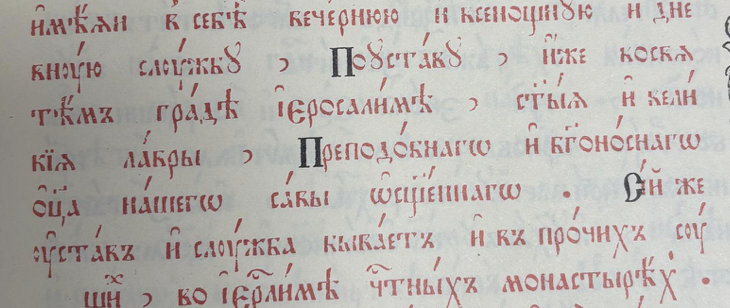
from the Book of Hours
His teacher sat across the table, fingers clenched, voice tense. “Try again. Next word.”
Wincing, Bartholomew pointed at a group of letters, and sounded out a guess.
A wrong guess.
The teacher stood up, muttering to himself. He walked around the table before taking a deep breath and speaking in that quiet, strained voice. “We have studied these letters for the past eight months, and you have made no progress.” He stopped pacing and looked the boy in the eyes. “Zero progress.”
That intense, low voice felt more painful to Bartholomew than if the teacher had yelled at him. He stared at the impossible scratchings.
“You will never learn to read. Perhaps you can learn to copy.” Placing a long, narrow stone beside the sheet of birch bark, the teacher sighed. “Trace the letters again.”
Bartholomew picked up the stone and started to scratch out the first letter on the soft surface, but he could not see very well. Tears blurred his eyes.
He would never be able to help read the services in Church.
The teacher opened the door and pulled a bell rope. At the sound, the rest of the boys ran in from recess. Bartholomew blinked a couple of times, looking at the ceiling.
Misha, a good-natured, lanky boy who was a little too ready with a joke, looked over Bartholomew’s shoulder. “Looks like you haven’t yet got one letter. How will you ever spell your whole name?”
Even his brothers, Stephen and Peter, laughed. Of course Stephen could read, because he was older. Peter, though, was younger, yet had no trouble reading aloud for the teacher or for their parents.
His parents.
Bartholomew closed his eyes. After the teacher’s report, his parents would scold him.
His cheeks flushed red with shame.
That night, he buried his face in his burlap pillow. Stuffed with buckwheat, the familiar smell of the grains should have comforted him. Instead, he repeated the words that had become his mantra over the past couple of weeks: “God, help me! My mind is completely dark! Shine some light in there for me! I can’t do it – I try and try and I just can’t do it. Please help me!”
With these words, he cried himself to sleep.
*
On the next day, his father sent him to the fields to look for a lost foal. Bartholomew walked quietly, eyes scanning the grasses and trees for the young horse. As he walked, he whispered. “Lord, I can’t learn. Lord, please be my teacher.”
To his right, a hedge of Russian pea shrub enclosed a field of wheat. Along the hedgerow, hundreds of yellow flowers stood watch like little guardian angels. The shrubbery led to a hill, and on top of the hill, a huge oak tree sat enthroned as if it had been there for a thousand years.
Under the oak tree, an old man in a dark cloak rested in the shade, whittling a piece of wood. He looked up and studied Bartholomew. When he spoke, his voice was warm and gentle. “What is bothering you, my boy?”
Bartholomew opened his mouth but closed it again.
The elder patted the ground. “Come sit with me a moment.”
Bartholomew obeyed.
“Now, I know something is wrong. No use trying to hide it from me.”
After a deep breath, Bartholomew began. “I love God. And want to serve him. And I want to please my parents and my teacher and my brothers. They all want me to be able to be a reader in the church one day.”
He watched the elder make small carving motions, removing bits of wood to reveal a little bird in his wrinkly hands.
The elder stopped working and turned to face him. “And you? Is that what you want?”
“Yes! Yes, I do!” His voice shrunk back. “But I cannot make out the words."
“Hmmph.” The elder reached over to his knapsack and pulled out a small piece of bread. It looked like the holy bread given after communion. “Take this and eat it.”
Bartholomew offered him a weak half-smile, and held out his hand. He didn’t know why the elder wanted him to eat a piece of prosphora, but he ate it anyway.
The elder then pulled out a heavy set of birch sheets and untied them carefully. He handed a sheet to Bartholomew. “Let’s stand up.”
Bartholomew took the sheet and scrambled up, wondering what random task he would be asked to do next.
The elder nodded at him. “It’s the Psalter. Go ahead and start chanting, please.”
“But—"
The elder raised one eyebrow and tilted his chin, questioning whether Bartholomew really wanted to argue. After a moment of silent confrontation, the boy lowered his eyes. The elder repeated, “Please start.”
Bartholomew looked at the sheet in his hands. Etched into the beautiful white bark were hundreds of small letters. To his surprise, they lined up obediently. He could group the letters into smaller sets that formed words, words that made sense! He began chanting the first psalm without any mistakes. It felt like someone else was chanting while he was watching from above, in shock.
As he finished the last sentence, his voice and his hands and his eyes were all singing in thanksgiving to God.
Smiling, the elder nodded and put the birch sheet back in the bundle. “Looks like God has a plan for you, after all, Sergius.”
The boy smiled at what he thought was the forgetfulness of the old monk. “Father, my name is Bartholomew.”
The elder shrugged his shoulders. “We’ll see about that.” He turned to go and added, “You know, you get a new name when you become a monk.”
The soon to be Sergius of Radonezh watched the mysterious monk hobble away.
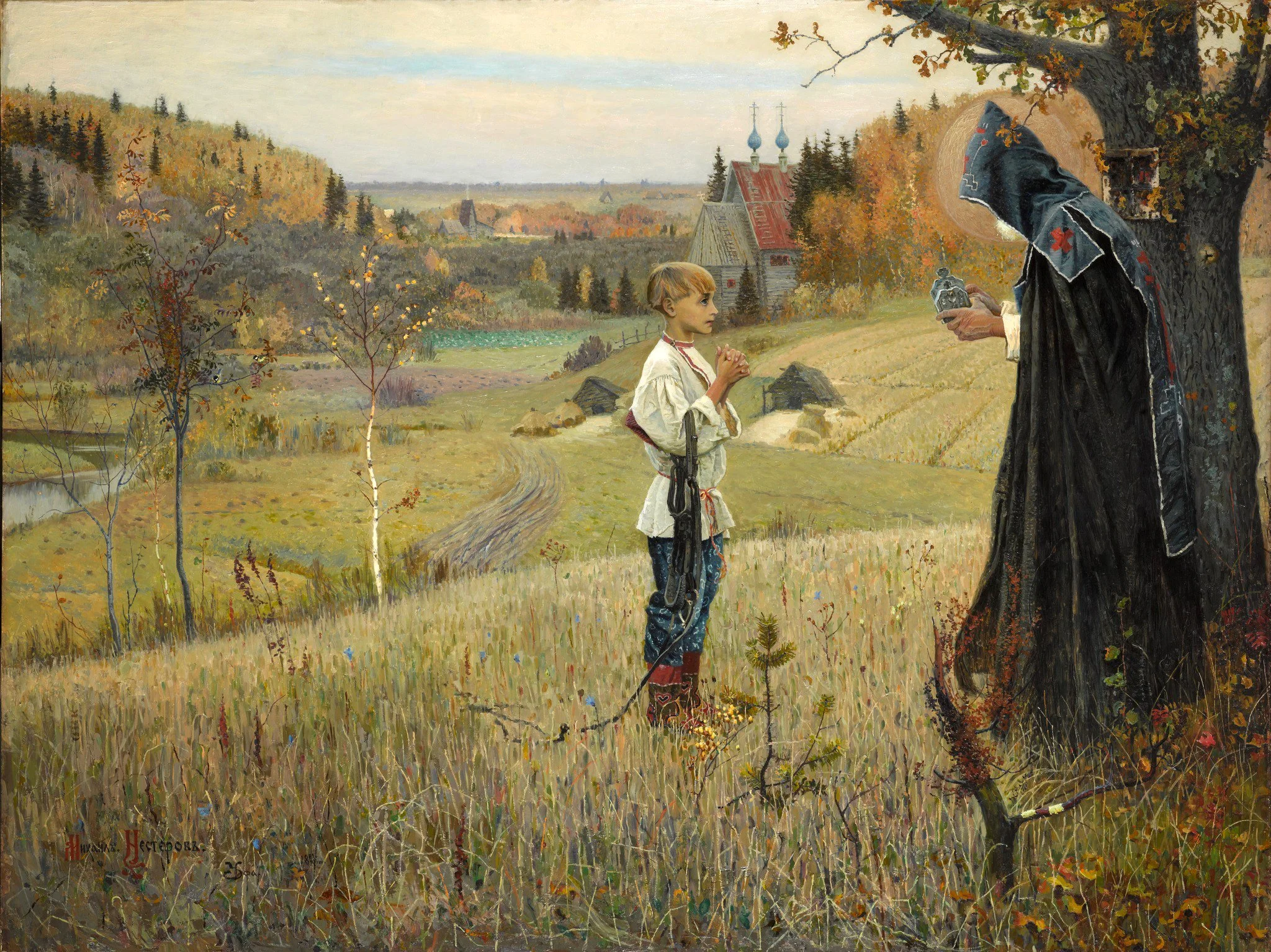
By Mikhail Nesterov - Unknown source, Public Domain, https://commons.wikimedia.org/w/index.php?curid=461843